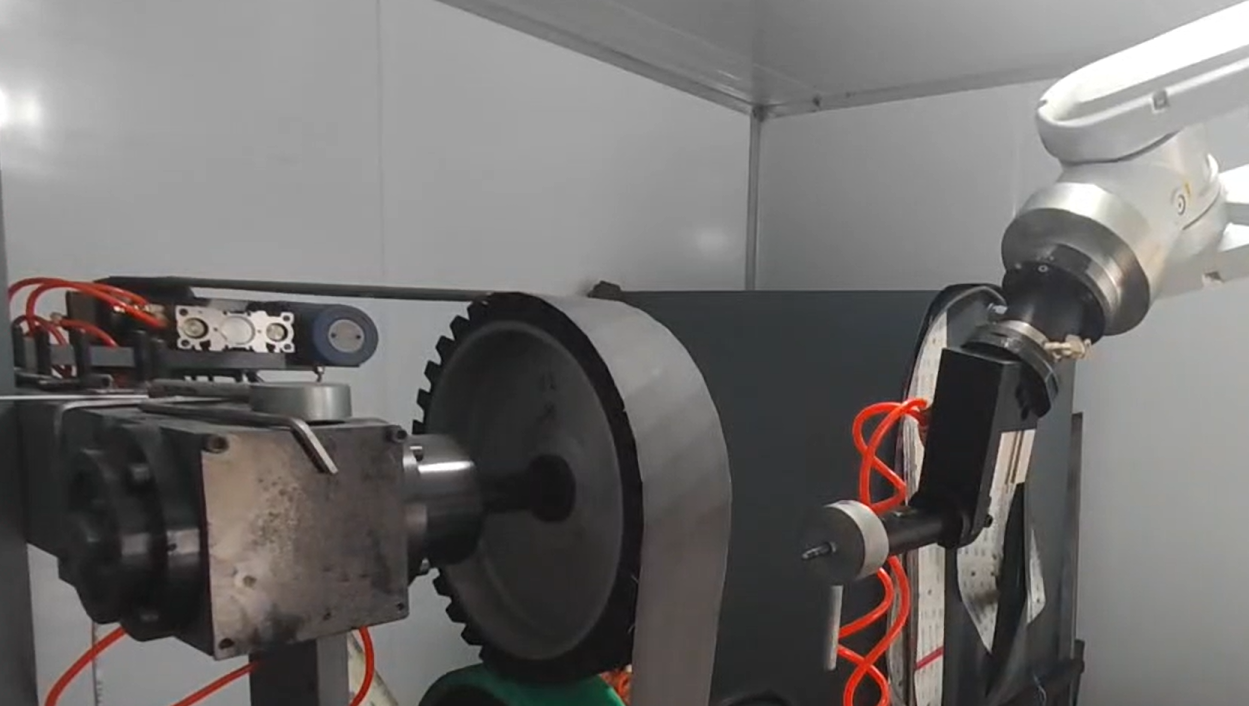
Pain Points in the Polishing Industry
Deburring is a critical post-processing step for aluminum die-cast parts, and also one of the most difficult, labor-intensive, and time-consuming. Today, die-casting plants performing manual deburring face multiple challenges: the process is inefficient, workpiece quality is inconsistent, and labor is hard to recruit and expensive — all of which drag down overall productivity and keep total costs high.
Industrial Robot Polishing
Automation upgrade solution:
To break through the bottleneck of manual deburring, automated polishing systems based on industrial robots are becoming the industry's direction of innovation. Compared with traditional manual methods, their core advantages span three dimensions:
-
Breakthrough in Efficiency and Throughput
-
Robots can operate around the clock, with a single unit equivalent to 3-5 skilled workers.
-
A case study at a well-known domestic die-casting company showed that after introducing robots, per-part processing time fell by 62% and average daily output rose by 200%.
-
-
Quality Consistency and Precision Control
-
Through force-sensing and vision positioning technologies, robots achieve ±0.1mm repeat positioning accuracy, eliminating individual variation in manual operations.
-
Tests on aluminum alloy components at an automaker showed that automated polishing cut the defect rate from 8.7% with manual operations to 0.9%.
-
-
Structural Optimization of Total Cost
Cost Dimension Manual Method Robot Solution Direct labor cost Avg. RMB 15,000/person/month (incl. training) Equipment depreciation ≈ RMB 3,000/month Quality loss cost 5-8% of output value Kept below 1% Long-term marginal cost Continuously rising Investment recovered in 3 years
Extended technical value:
-
Flexible production capability: through rapid changeover programs, a single workstation can handle 20+ different types of castings, adapting to the trend of small-batch customization.
-
Closed-loop data management: polishing parameters are uploaded to the MES system in real time, enabling digital process traceability and providing decision support for lean production.
Key Advantage Comparison
Industrial robots not only solve the efficiency and quality pain points of manual operations, but also reshape the production value chain through a standardized operating system. Although the initial investment is higher than manual labor (approximately RMB 400,000–800,000 per unit), within a two-year operating cycle the efficiency gains (higher throughput), quality dividends (lower scrap rates), and hidden cost savings (reduced injury risk and management losses) reverse the total-cost equation, giving die-casting companies a sustainable competitive edge.
Polishing Capabilities
Supports automatic grinding wheel changes for multiple types of polishing, with the robot automatically polishing multiple times from different directions. Polishing types include:
• Removal of weld spatter.
• Removal of surface dents and scratches.
• Flattening of weld reinforcement.
• Flattening of machining allowance.
• Polishing of long, large welds.
• Removal of edges and burrs.
Combined with external-axis equipment such as positioners, it can polish large sheet-metal parts, ensuring smooth, even results.
Combined with offline programming, it enables compliant polishing of complex curved surfaces.
Combined with line-scan laser tracking technology, the following automated polishing programs can be implemented:
-
Straight line defined by 2-point positioning.
-
User coordinate system defined by 3-point/4-point positioning.
Polishing Scenarios
Scenario 1
Scenario description:
-
Polish a straight segment;
-
1 polishing pass at a 0° polishing angle (the angle of the current teach point), then start polishing;
-
After polishing, wait for the signal to continue.
Scenario 2
Scenario description: polish a straight segment — 4 passes at the taught position, 2 passes tilted +15°, and 2 passes tilted −15°.
Scenario 3
Scenario description: the polishing head has worn 1mm and parameters need to be adjusted.
Setup steps:
Go to Process / Polishing Process / Polishing Parameters, select the corresponding process number, and click Modify;
Enter 1 for tool wear compensation and click Save;
Setup complete — run the program.
Scenario 4
Polish a straight segment — 4 passes at the taught position, tilted +15°, and 2 laser seam-finding polishing passes.