Product Introduction
Radiant like a star and truly exceptional, the X01 — Star One collaborative robot control cabinet — uses proprietary control and dynamics algorithms, featuring dynamics-based drag teaching, collision detection, and dynamics feedforward. It delivers smooth, compliant drag teaching and can record and replay trajectories.
Compact and highly integrated, it is far more portable than comparable products. Plug-and-play simplifies installation and deployment — no tedious configuration or commissioning is required; just a few simple connections and you're ready to go.
Built on the Intel Edge Controls for Industrial (ECI) platform, it meets industrial-grade requirements for real-time computing and high operational availability. It delivers deterministic, time-critical computing even in dense environments, with exceptional reliability and stability.
Product Advantages
Dynamics Technology
iNexBot Technology's load-aware dynamics technology requires no sensors to improve drag smoothness under load and collision-detection sensitivity during impacts. With mechanical feedforward, it noticeably suppresses vibration in large-payload robots during operation, both with and without a load.
iNexBot's dynamics identification process is fully automatic: once the test trajectory passes safety validation, the robot automatically runs the preset trajectory to identify the dynamics parameters — no manual calculation required.
Click to watch the dynamics identification video
Drag Teaching and Trajectory Replay
Supports dynamics-based drag teaching with trajectory recording and replay.
Click to watch the drag teaching demo video
Specifications
| Item | Specification |
|---|---|
| CPU | Intel® Celeron J6412, 2.6 GHz |
| Memory | 4G |
| Power input | 220V 10A |
| Power output | 48V |
| Power consumption | 1500W/3000W (optional) |
| OS | Linux RT |
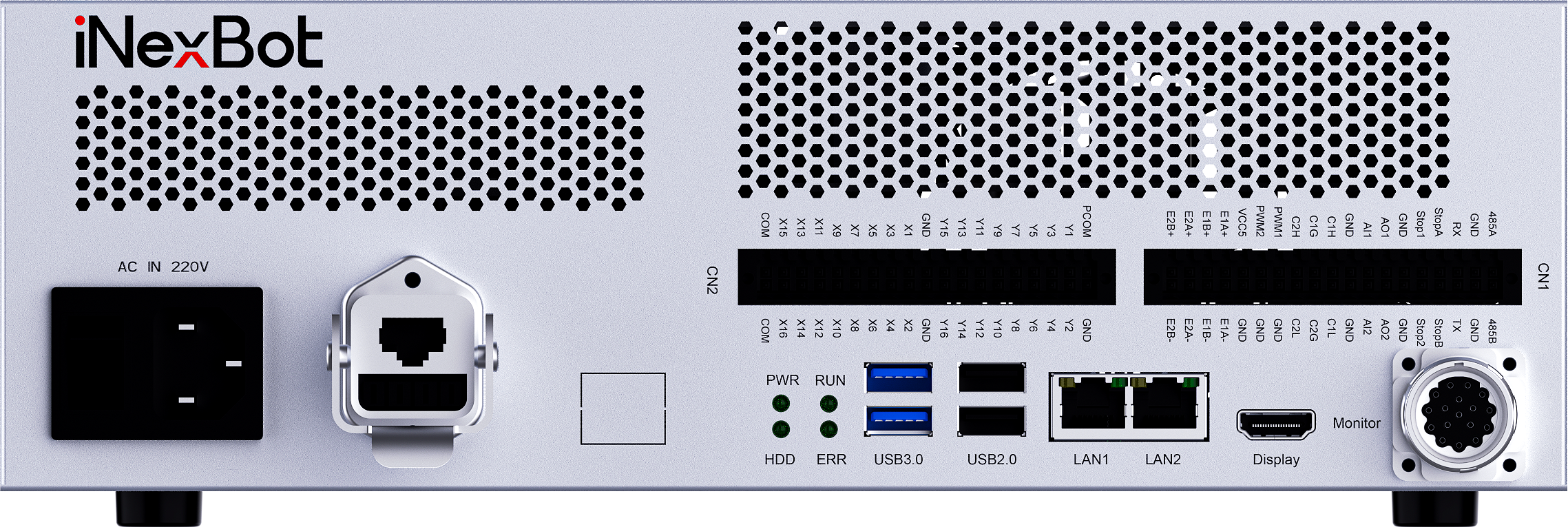
| Network ports | 1*EtherCAT, 3*Ethernet |
| USB | 2*USB 3.0 |
| COM | 1*RS232, 1*RS485, isolated |
| I/O | 16*isolated DI, 16*isolated DO, 2AI (0-10V), 2AO (0-10V) |
| CAN | 2*CAN |
| Indicators | 1 x PowerLED, 1 x HDDLED, 1 x RUNLED, 1 x ERR LED |
| Display | 1 x HDMI, resolution up to 4096x2160@30Hz |
| Mounting | Desk-Mount |
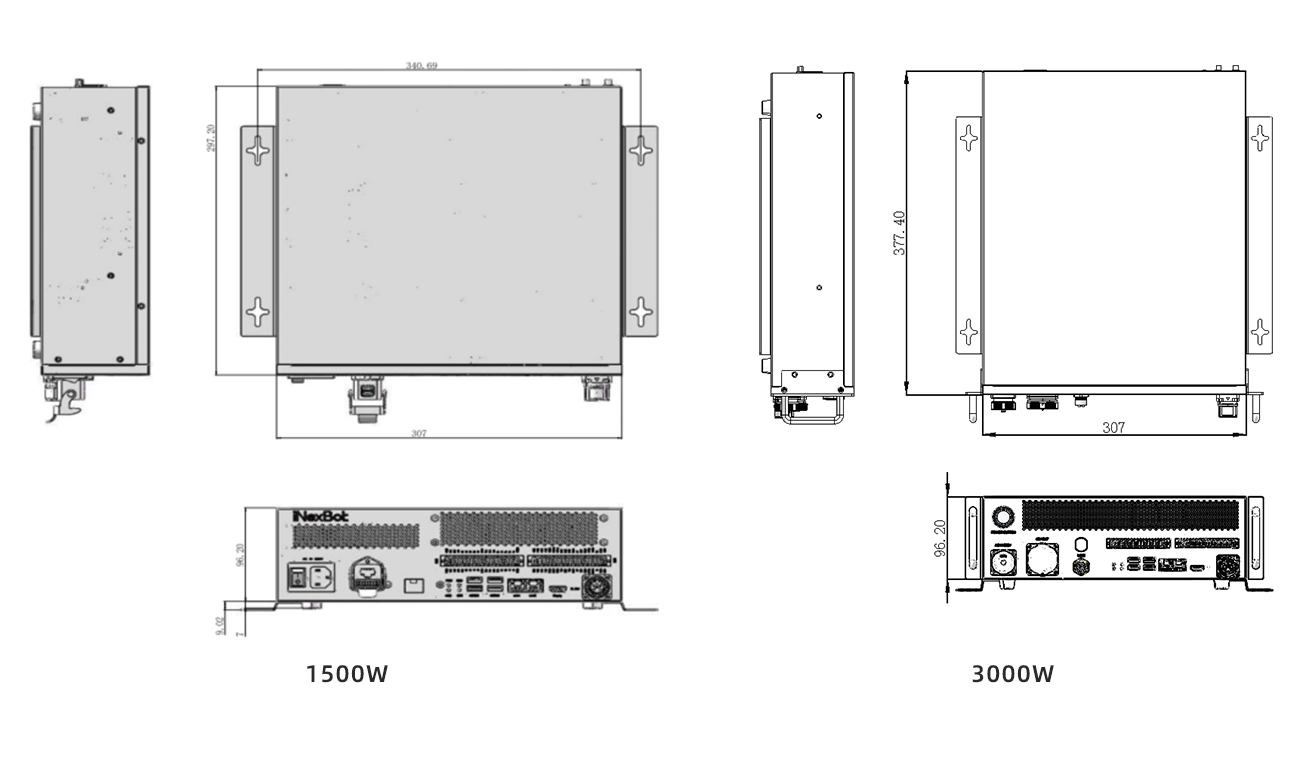
| Dimensions | 307mm x 297.20mm x 96.20mm |
| Encoder | A/B phase differential input, 5V power output; 32-bit signed counter, 2 channels |
| PWM | 2-channel output, single-ended, duty cycle adjustable 0-100%; voltage 5V or 24V, frequency up to 1MHz |
| WIFI | (Optional) 2.4G WiFi module |
| Teach pendant | (Optional) T30-X teach pendant for collaborative robots: 8-inch TFT full touchscreen, Linux+QT |
| Communication protocols | EtherCAT, Profinet, Ethernet/IP, CAN, OPC-UA, FinsTCP, TCP/IP, ModbusTCP, ModbusRTU |
| Operating modes | Teach mode, play mode, remote mode |
| Programming methods | Teach programming, offline programming, drag teaching |
| Coordinate systems | Joint coordinate system, robot coordinate system, tool coordinate system, user coordinate system |
| Structure algorithms | 5/6/7-axis collaborative robots |
| Applications | Arc welding, TIG welding, laser welding, resistance welding (spot welding), stamping, loading/unloading, laser cutting, spray painting, dispensing, palletizing, conveyor tracking, etc. |
| Operating temperature | 0℃ ~ 50℃ (SSD) |
| Storage temperature | -40~85℃ |
| Humidity | 5% ~ 95%, non-condensing |
| Vibration | SSD: 5~500Hz, 1.5Grms operation |
| Mechanical shock | Operation: 10G@11ms, Non-operation: 30G@11ms |
| Net weight | 6.92Kg |
Product Interface Diagram
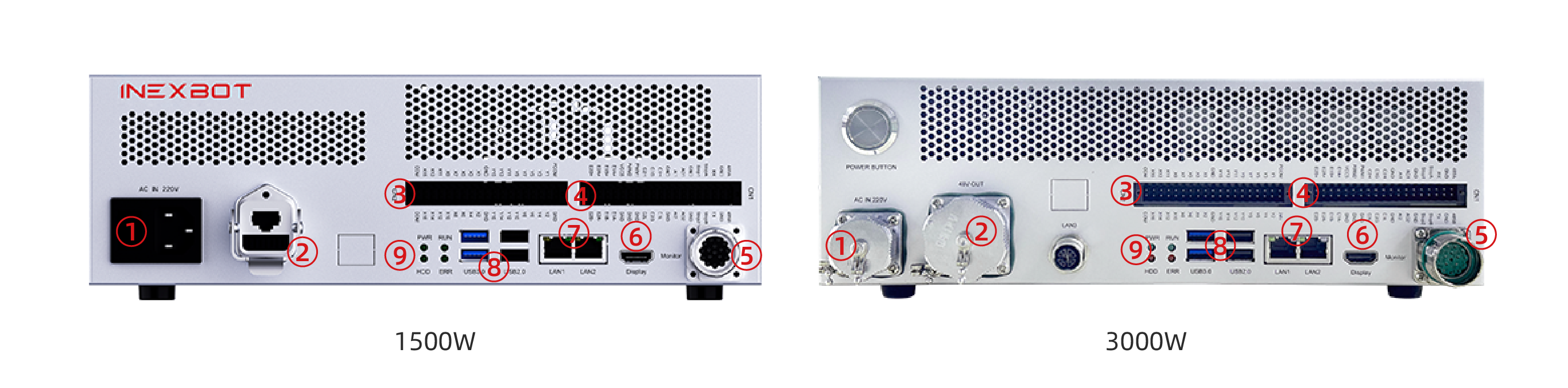
| No. | Item |
|---|---|
| 1 | Power input interface |
| 2 | Robot aviation connector |
| 3 | DIO |
| 4 | Serial ports, encoder, PWM, analog, CAN |
| 5 | Teach pendant interface |
| 6 | HDMI |
| 7 | Ethernet interface |
| 8 | USB |
| 9 | Status indicators |
Dimension Drawing